Why MRP Feels So Logical—and Why It Isn’t
Material Requirements Plan (MRP) logic seems so straightforward and compelling. Start with your demand and MRP, using your bill of material and item lead times, will backwards schedule what you need to buy, then assemble or manufacture, then distribute to meet the expected demand.
What else would you do?
But the logic has two fundamental, and seriously flawed assumptions!
This post will focus on the demand signal accuracy and variation in the automotive supplier environment.
The Two Assumptions MRP Depends On
Assumption #1: Demand Will Not Change
First, MRP assumes that the future demand is accurate and will not change. In forecast driven environments, the demand figure is rarely correct.
In Make to Order environments customer requirements are often changing their future requirements, period to period, as their needs change.
Assumption #2: There Will Be No Variation
Second, MRP assumes there will be no variation. MRP assumes that every supply order arrives on time. That manufacturing orders complete on time and that distribution orders all complete on time. The reality is that the MRP assumption of no variation is not proving valid.
What OEM Demand Volatility Looks Like in Reality
The following is a historical demand waterfall of a part in a tier 1 automotive supplier highlighting the forecasted demand signals sent by the OEM over the 13 weeks preceding the actual week of production.
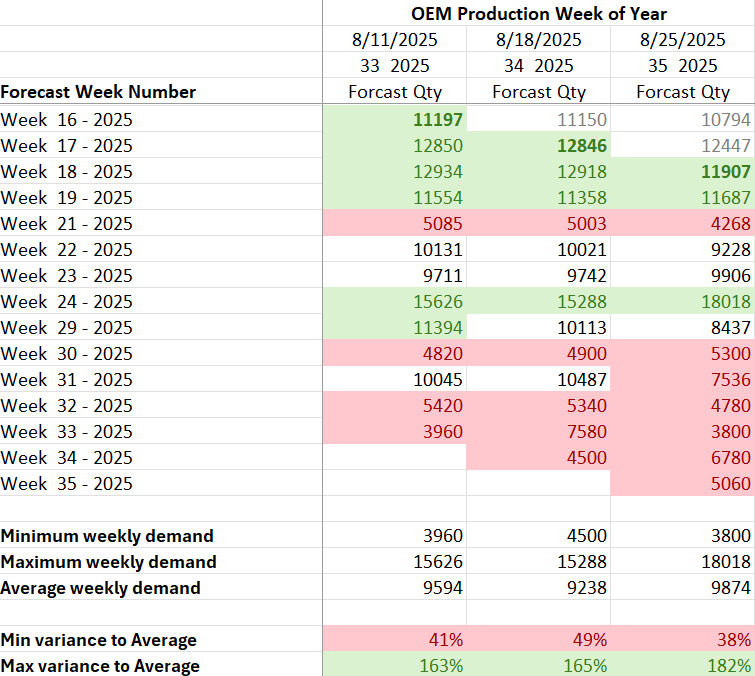
The columns represent the OEM production week when the demand must be satisfied. The rows represent the OEM demand signal that was sent to the supplier over the preceding weeks leading up to each of the production weeks.
Green cells indicate periods where the forecasted demand signal was more than 15% above the average weekly demand in the 13 week horizon. Red cells indicate when the forecasted demand signal was more than 15% lower than the average weekly demand in the 13 week horizon.
How Forecast Noise Evolves as Production Approaches
Progressing through the forecast weeks toward the production week there is substantial movement in the demand signal being sent to the supplier. The variation range is quite high with the lowest demand signal in the 13 week period typically more than 50% lower than the average while the largest demand in the horizon was more than 60% higher than the average.
Each week, the MRP run for the supplier will reshuffle the supply order deck, moving some orders in earlier to address increases in demand or pushing others out when the demand signal moves downward. A never ending quest to align supply with an ever changing demand signal.
The bullwhip effect in living color!
The Operational Cost of System Nervousness
The resulting system nervousness results in excessive workload for planners and buyers who work to deal with the changes in the demand signal from the OEM.
Why This Problem Isn’t Going Away
The reality is that the signal variation from the OEM to the Tier 1 suppliers is not going away. It’s been this way for decades and, if anything, it’s likely to get worse going forward as competition within the industry as the range of vehicle choices continues to increase.
Fundamental change is needed in the approach automotive suppliers follow to addressing the erratic demand from their customers.
What DDMRP Changes in a Volatile Environment
DDMRP concepts promote constant availability of materials enabling suppliers to have confidence that they’ll have the stock available to meet actual demand while doing so without excess inventory.
DDMRP’ buffers provide constant availability of material and are sized to meet the rate of demand AND the level of demand variation an item experiences.
Decoupling Demand Volatility from Supply Execution
The result is a decoupling of the demand signal from the resulting supply requirements. The variation caused by the OEMs is no longer transferred directly to the suppliers.
Orders aren’t sent to suppliers with request dates in the past. The existing supply orders aren’t changed. Order fill rate to the OEM improve and are achieved with far less expedited freight spending.
You can learn more by accessing our recent webinar recording on this topic.