DDOM
Let’s Simplify the Management of our Supply Chains
Simplify supply chain management by reducing complexity and focusing on true market signals for dramatic results in efficiency and inventory...
Are forecasts really reliable in supply chain? Exploring short- and long-term use cases, S&OP, demand sensing, and best practices.
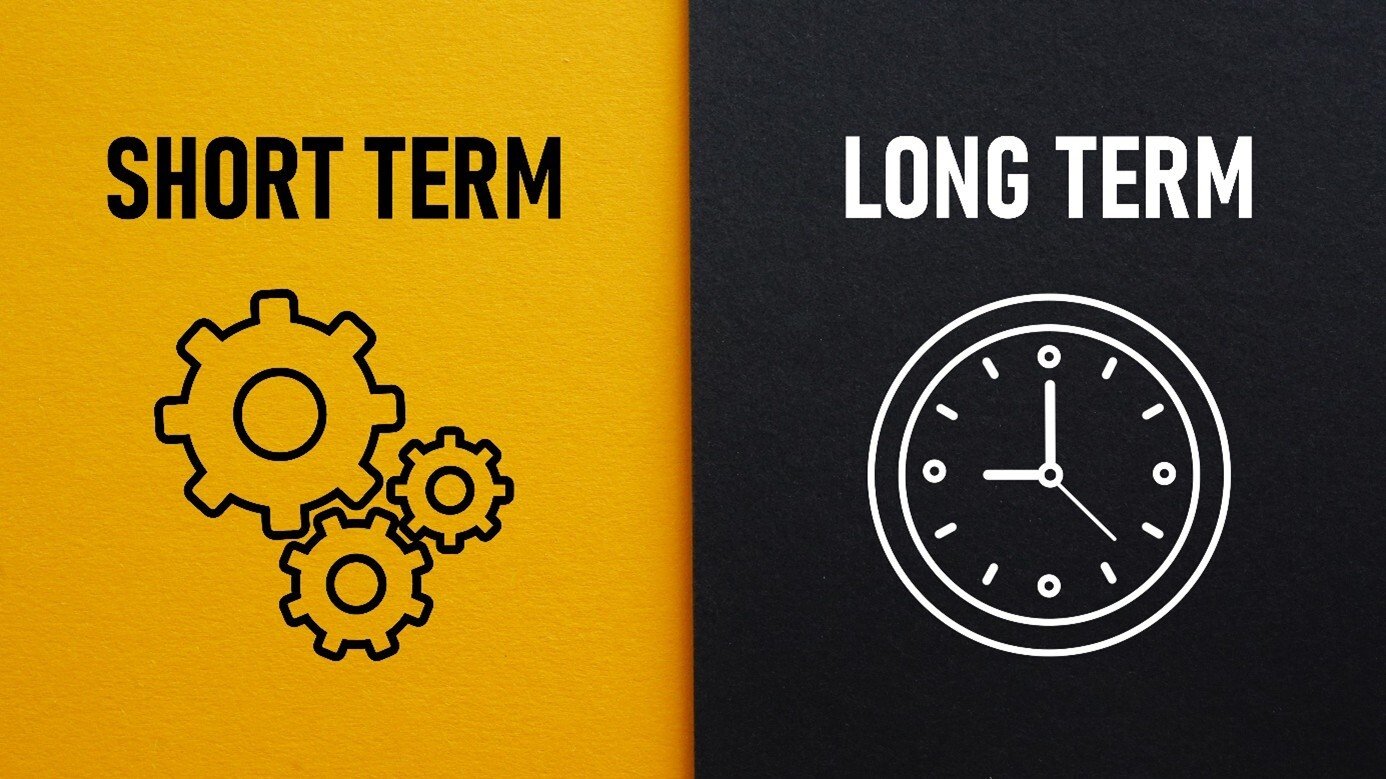
Supply chain management relies on forecasts, whether implicit or explicit.
Sizing inventory based on past average consumption assumes that future consumption will resemble this history, so it is an implicit forecast.
Let's be honest, no one trusts forecasts. Everyone knows that actual demand will differ from forecasts.
The Demand Driven Institute points out that:
But when are forecasts most useful?
The usefulness of a forecast is measured by its ability to inform a decision.
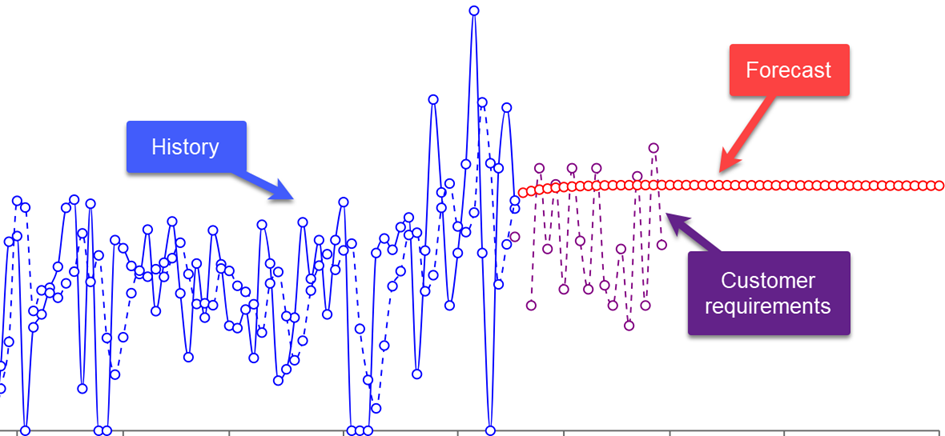
Let's look at the graph below, which shows, on the one hand, in solid blue, the history of demand, in red, the statistical forecast based on this history, and in purple dotted lines, the customer requirements communicated for the coming weeks.
What can we deduce from this graph?
On the one hand, we can see that in the short term—in the case of this B2B flow, 16 weeks—we have a better demand signal than the statistical forecast. It is probably better to trust the purple dotted line than the red projection.
However, we are not necessarily going to blindly believe these figures. A customer requirement shared for the next 16 weeks is likely to change, and if we view this graph week after week, chances are we will see that the purple sinusoids fluctuate from week to week. The signal is undoubtedly better, but it is noisy. It is still a forecast, except for the very beginning of the horizon, where the customer delivery call is definitive.
Beyond 16 weeks? Well, there's no choice: all we have is a forecast. So, if you have to make decisions beyond 16 weeks, the best information you have—or the least bad—is the forecast, based on an analysis of historical data and enriched with any causal factors.
Do you need to make decisions beyond 16 weeks? Most likely, for example, investing in new equipment to increase capacity will take more than 16 weeks.
We can therefore conclude from this example that, in the long term, forecasting is useful—especially for your S&OP process. That's a shame, because the further ahead the forecast is, the more inaccurate it is, right?
The key to making this distant, and therefore grossly inaccurate, forecast useful - i.e., helping you make good decisions—is to treat it at the most aggregated possible level and to evaluate several assumptions and scenarios.
In the short term, you will rightly say, we must consider the actual demands expressed by the customer—and forecasts are not relevant. You are probably right, based on the previous example.
But let's imagine for a minute that you are a physical retailer or an online retailer. You don't have any firm orders. A visitor will enter one of your stores or log on to your website and make a purchase... provided you have the item in stock. Otherwise, the sales will be lost.
How can you ensure availability? You need a relevant signal to restock your store or warehouse. The first and most natural signal is to renew consumption. This is the pull flow principle at the heart of Intuiflow. We time restocking to the pace of actual consumption, possibly adjusted for causal factors such as promotions.
In this context, a very short-term forecast can also be useful. It may allow for more detailed replenishment of a particular point of sale, because the weather forecast for this coastal town on Saturday predicts beautiful weather, it is the first Saturday of the holidays, and there is a local fair that is expected to attract many visitors. Our Algo retail expert colleagues have developed very convincing AI and replenishment algorithms in this area.
In fact, in the very short term, a highly detailed forecast can be useful for decision-making—although the more detailed it is, the more likely it is to be wrong...
I propose the following assumptions:
In the long term, an aggregated forecast broken down into scenarios can be useful for informing decisions and preparing the company to adapt.
In the short term, actual orders and consumption are a better indicator—except in retail/e-commerce use cases where more relevant causal information can be captured by an algorithm: a local event, an influencer's feed, etc. This article describes well the importance of demand sensing in retail applications.
To be effective, this requires that you properly designed your supply chain with decoupling points to enable frequent and fast replenishment.
In the very short term, a highly detailed forecast can be useful. The weather forecast for your city for the coming hours is undoubtedly useful when deciding whether to take your hoodie as you go out.
In between? It's up to you to define your pragmatic adaptation model... Feel free to contact us so we can help you through this process!
Simplify supply chain management by reducing complexity and focusing on true market signals for dramatic results in efficiency and inventory...
How implementing DDMRP can reduce lead times by redesigning flow models, not just relying on software. Learn effective strategies from real-world...
Optimize your supply chain in 2025 with resolutions for flow protection, relevant information focus, and adaptability. Implement these strategies for...